DIALOGUE: UNITED FOR CHANGE: LEAVING NO ONE BEHIND IN THE FIGHT AGAINST TRAFFICKING IN PERSONS.
Opening Remarks by Ms. Pauline Tamesis, UN Resident Coordinator in Viet Nam
Colonel Le Hoang Duong, Deputy Director of the ministry's Department of Foreign Relations
Excellency Marcus Winsley, Charge d’Affaires of the United Kingdom to Viet Nam;
Excellencies Ambassadors; Representatives of the diplomatic corps and international organizations;
Leaders and representatives of ministries;
Officer in Charge of IOM;
Distinguished participants;
And my greatest honour today is welcoming more than 200 young CHANGEMAKERS,
On behalf of the United Nations in Viet Nam, I thank the Government of Viet Nam, particularly the Ministry of Public Security, and the UK Government for organizing this important event to celebrate the National and World Day Against Trafficking in Persons.
Today, we gather under this year’s theme - “Human Trafficking is Organized Crime – End the Exploitation.” This is a moment of reflection, recognition, and recommitment, acknowledging the tireless efforts of the counter trafficking community, who have worked hand in hand to effectively combat this crime.

It has been 14 years since Viet Nam’s Trafficking in Persons (TIP) Law came into effect. The Government of Viet Nam has issued National Plans of Action on Combating and Preventing Human Trafficking every 5-year since 2005. In particular, the 4th National Plan of Action for the period of 2021-2025, with a vision to 2030, is a cornerstone of the national efforts.
The revised Law on Human Trafficking Prevention and Combat in 2024 is also a landmark achievement. It strengthens the legal framework to address the evolving nature of trafficking in persons and reinforces a whole-of-government approach that better prioritizes victim protection, inter-agency coordination, and survivor-centred justice.
These efforts by Viet Nam to promote safe migration and prevent human trafficking deserve high praise.
Now, let us look at the challenges.
Across the Asia–Pacific region, trafficking in persons has become more complex. Following the COVID-19 pandemic, Southeast Asia has witnessed a sharp rise in scam compounds operated by transnational criminal groups. They employ sophisticated online schemes to commit large-scale fraud.
According to IOM’s Regional Situation Report on Trafficking in Persons into Forced Criminality in Online Scamming Centres, the number of trafficking victims forced into criminal activities, who received IOM’s support in Southeast Asia, more than tripled, from 296 in 2022 to 1,093 so far in 2025.
The profile of these victims is changing. They are young. They are educated. At least 50% hold university degrees. Lured by promises of high-paying jobs, they end up having their passports confiscated, be subjected to confinement, violence, sexual abuse and coercion into carrying out scams.
This is the new trend in human trafficking: highly organized, transnational, and increasingly shifting into digital space.
But there is hope. And that hope is sitting right here in this room.
Last year, I had the opportunity to engage with some of the young changemakers leading IOM’s efforts to promote safe migration and combat human trafficking.
One year on, I am proud to learn that through 14 impactful initiatives, your work has directly reached over 11,800 individuals and engaged more than 780,000 people online, an inspiring testament to your dedication and determination to prevent this crime.
From virtual escape rooms game to AI-powered applications, I am truly encouraged by your plans to leverage technology more strategically in amplifying messages on safe migration.
On behalf of the United Nations in Viet Nam, I also extend my sincere congratulations to you all. Your creativity, energy and digital fluency position you to develop innovative solutions to combat trafficking in the digital age. Investing in youth not only protects their peers but also strengthens community resilience.
This year’s theme underscores the need to dismantle trafficking networks through coordinated law enforcement and justice sector responses while ensuring that survivors are fully protected.
This October, Viet Nam will host the signing ceremony of the Hanoi Convention against Cybercrime, the first-ever global treaty dedicated to addressing cybercrime. The event will mark a pivotal moment in international cooperation against cyber-enabled crimes, including human trafficking.
Once again, we are reminded that the future of this endeavour lies in collaboration, innovation, partnership, and youth leadership. We cannot end human trafficking without the contribution of each of you here today.
Together, we stand united in confronting these challenges, supporting victims, holding perpetrators accountable, and striving for a world where no one is bought, sold, or exploited.
Let us continue to harness the creativity, energy, and determination of Vietnamese youth to tackle the complexities of the digital age.
Together, we can turn the tide against trafficking in persons. We can build a future where every person thrives in safety and dignity.
Thank you. Xin cảm ơn.



Speech by
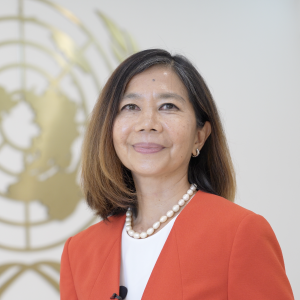
Pauline Tamesis
Goals we are supporting through this initiative