
Viet Nam Maritime Forum 2026: "Advancing International Cooperation and Integration for a Strong Maritime Viet Nam"
High-Level Orientation Session: "One Maritime Space – One Action Plan – One Coordination Mechanism"
Keynote Remarks by Ms. Pauline Tamesis United Nations Resident Coordinator in Viet Nam
Excellencies,
Snr. Lt. Gen. Nguyen Doan Anh, Member of the Party Central committee, Vice Chairman of the National Assembly;
Mr. Nguyen Duy Hung, Deputy Chairman of the Central Commission for Policy and Strategy;
Deputy Minister of Foreign Affairs Nguyen Manh Cuong;
Deputy Minister of Science and Technology Tran Trung Tinh;
Deputy Minister of Culture Ho An Phong;
Excellencies, distinguished leaders,
Xin chào and a very good morning to you all.
I thank the Ministry of Foreign Affairs for convening this Forum, and I was reflecting on the theme of international cooperation and the following session on One Maritime Space – One Action Plan – One Coordination Mechanism.
These words capture something the world has been slowly learning. For a maritime nation, the ocean is not one sector among many. It is the space where sovereignty, security, food, livelihoods, climate, and development all meet. The ocean does not recognise boundaries between our ministries, sectors, or treaties.
Fish stocks, currents, pollution, and warming waters move across all of them. The ocean is one, and our plans, institutions, and partnerships must act as one too.
This morning I would like to do three things: set out where the global ocean agenda stands; show how Resolution 20 connects Viet Nam to it; and suggest what Viet Nam can contribute to global efforts.
Let me start with our shared global promise: Sustainable Development Goal 14
The ocean regulates our climate, feeds billions of people, and carries most of world trade. Yet it is under unprecedented pressure from the triple planetary crisis of climate change, biodiversity loss, and pollution.
For a country like Viet Nam, these are not abstract threats. With over 3,000 kilometres of coastline, a Mekong Delta exposed to sea-level rise and saltwater intrusion, and millions whose livelihoods depend on fisheries, aquaculture, shipping, and tourism, ocean health is inseparable from national economic and human health.
This is why Sustainable Development Goal 14, "Life Below Water," matters so much. It asks us to reduce marine pollution, protect ecosystems, end overfishing and illegal fishing, conserve marine areas, strengthen ocean science, and implement international law under UNCLOS. With four years to go, the world is not on track, and SDG 14 remains one of the least funded global goals. Resolution 20 arrives at an important moment, showing how Viet Nam intends to deliver its share on the same timeline.
The Resolution calls for a profound shift in thinking:
From exploiting the sea to governing it.
From a coastal economy to a strong maritime nation.
From managing sector by sector to governing national maritime space as one integrated whole.
Viet Nam sees its maritime economy as a way to expand and diversify growth, pairing ambition with stronger institutions and laws while stating clearly that the environment will not be traded for mere economic growth. Crucially, it places this within the protection of sovereign rights and jurisdiction under international law. Development, environmental stewardship, and sovereignty reinforce one another.
Resolution 20 aligns closely with priorities advanced through the 3rd UN Oceans Conference commitments or the Nice Ocean Action Plan. Alignment is demonstrated in at least 4 actions:
Expanding marine protected areas: Protecting at least 6 per cent of sea areas by 2030 and restoring mangroves, coral reefs, and seagrass beds, contributing to the global 30x30 target.
Decarbonising maritime transport: Committing to green, smart ports, clean-fuel infrastructure, and new industries like green hydrogen and ammonia, supported by 6 to 17 gigawatts of offshore wind between 2030 and 2035.
Combating marine pollution: Targeting full collection and treatment of coastal plastic waste and island waste treatment backed by a circular economy.
Unlocking finance: Calling for diversified investment, green finance, risk-sharing, preferential credit, insurance, and social protection for fishers and island communities.
Excellencies, our collective action is backed by International Law,
The 1982 UN Convention on the Law of the Sea (UNCLOS) is the "constitution for the oceans," providing predictability on zones, navigation, resources, and peaceful dispute settlement. Viet Nam has placed the Convention at the heart of its maritime policy.
The newest pillar of the Convention is the BBNJ Agreement on biodiversity beyond national jurisdiction, which entered into force on 17 January. Viet Nam has been a constructive partner from negotiations to ratification. With the first Conference of the Parties in January 2027, Viet Nam has a real opportunity to champion equity and send its experts to serve in the new institutions.
Concretely, what can Viet Nam contribute?
Viet Nam brings four things to the world:
First, a bridge: Connecting Southeast Asia, the wider Indo-Pacific, Pacific Island countries, and ASEAN across shared interests in UNCLOS, sustainable fisheries, and climate resilience.
Second, fisheries and economic sovereignty: Modernising fleets and ending illegal, unreported, and unregulated fishing as lessons for many coastal States.
Thirds, frontline climate experience: Offering deep insights into how sea-level rise and salinity affect communities and ecosystems to inform global adaptation.
Fourth, a voice for balance: Balancing economic opportunity in new frontiers with science, foresight, and equity.
Let me close where I began, with coherence.
The next phase of ocean governance depends on connecting UNCLOS, the BBNJ Agreement, climate frameworks, SDG 14, and regional cooperation into one architecture. This is where the United Nations can add value.
Just as Viet Nam is building one maritime space, one action plan, and one coordination mechanism, the UN system in Viet Nam works as one in support of those priorities. Through our UN Country Team and UN ocean agenda experts, we stand ready to help align the Resolution's action programme with national commitments, strengthen implementation capacities, mobilise partnerships and finance, and ensure benefits reach coastal and island communities.
Distinguished delegates,
Viet Nam has set out an ambitious vision to become a strong maritime nation. The ocean is one, our responsibility is shared, and our action must be joined.
The United Nations is proud to be your partner in that endeavour.
Thank you. Xin cảm ơn!


Bài phát biểu của
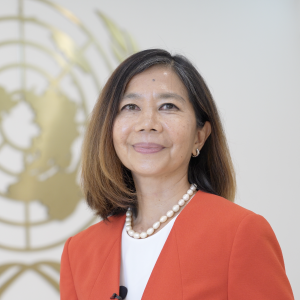
Pauline Tamesis
Các mục tiêu chúng tôi đang hỗ trợ thông qua sáng kiến này


